Writing
Notes on machine learning, space systems, and building software. Most of them work through something I got wrong the first time. Subscribe by RSS.
Every useful orbit holds something still
21 November 2026. The first figure from the post, running here.
Read the post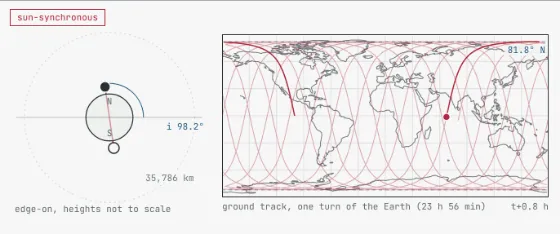
Machine learning & evaluation
7 posts
How rare-event models should be measured, calibrated, and doubted.
-
Where early prediction fails
BEACON reaches 0.806 PR-AUC one day out and 0.233 at the earliest available observation. Why the collapse is partly measurement, mostly missing information, and what still survives.
-
Rare events are a measurement problem, not a modelling problem
With twelve positives in a test split, the gap between two models is smaller than the noise from reshuffling the split. Why the binding constraint is the split, the baseline, the metric, and the number of repeats.
-
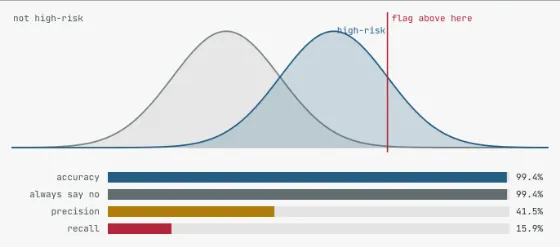
Accuracy is the wrong question for rare events
A model that flags nothing is 99.4% accurate on satellite conjunction data and completely useless. What I measured instead while building BEACON: PR-AUC, calibration, and ensemble uncertainty as a human-review signal.
-
The Laplace approximation, and where it stops working
A posterior over logistic regression weights for the price of one matrix inverse. The derivation, why confidently classified points contribute nothing to parameter uncertainty, and the five ways it fails.
-
Bayesian-inspired is not Bayesian, and the difference matters
BEACON contains a real posterior and a bootstrap ensemble, and calls them different things. Which sentences each one entitles you to write, and why the cheaper method was enough.
-
Your split is leaking and your metrics are lying
Splitting grouped data by row instead of by group inflates every metric you report. How event-level splitting works, why label metadata is the same mistake in disguise, and why one split is never a result.
-
The paper reported 0.59. I got 0.90.
Reproducing Maloku & Maloku (2024) on the same dataset moved linear regression’s test R² by 0.31. The cause was one preprocessing step, and cross-validation then reversed my own conclusion.
Space & geospatial
11 posts
Orbital and Earth-observation work: what remote measurement can tell you, what it cannot, and how to build instruments that admit the difference.
-
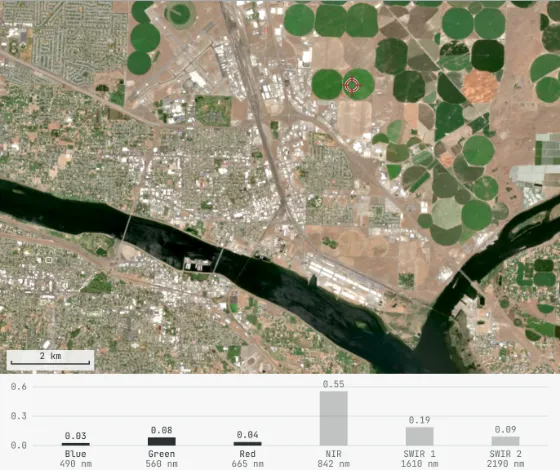
How a model sees a satellite image
A per-pixel land-cover model is never shown the picture. It gets a table of reflectances, one row per pixel. One real Sentinel-2 scene, classified four times with four different inputs, with interactive figures for the bands, the table, and what more bands cannot fix.
-
Every useful orbit holds something still
Geostationary, sun-synchronous and Molniya orbits each cancel one motion against another. A figure you can drag redraws the ground track as height and inclination change, and shows why the orbits worth having are such thin targets.
-
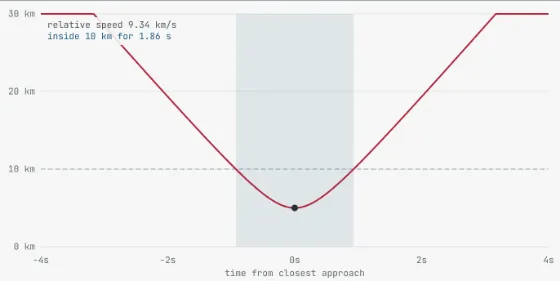
From two orbits to one number
A conjunction lasts about a second, which is what licenses collapsing two orbits in three dimensions into a flat integral. The encounter plane, why along-track uncertainty dominates, and why the crossing angle decides how much of it counts.
-
A geocode is not a location
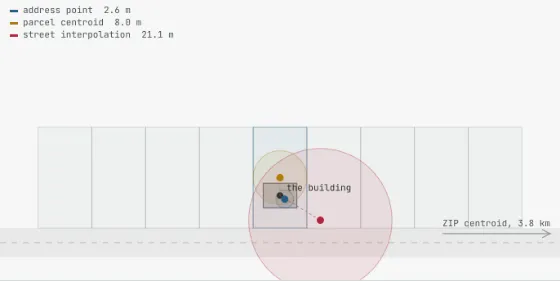
A geocoder returns coordinates and a match type, and only one of them survives the pipeline. What the four tiers actually are, why parcel centroids carry bias and street interpolation carries variance, and why point-in-polygon is the operation that will not tolerate either.
-
Your validation set is next door
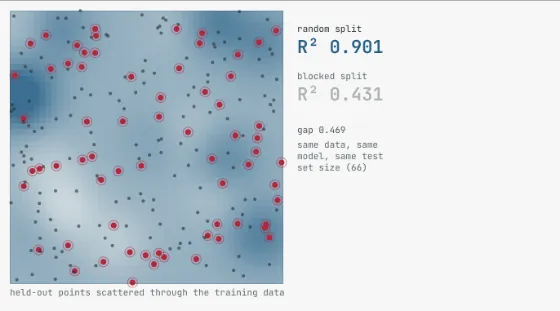
Spatial data breaks the assumption cross-validation rests on. A random split puts held-out points a few hundred metres from training points, so the score describes interpolation rather than prediction. Blocking, how big the blocks should be, and the good objection to all of it.
-
Observation, estimate, inference
Satellite conjunction triage and commercial property intelligence are the same problem: remote observations turned into a number someone acts on. Why every value needs its evidence tier attached.
-
A research interface should show its own seams
BEACON's 3D viewer renders uncertainty it cannot physically justify, so it labels the mapping a proxy in the interface, displays which geometry fallback is active, and watermarks its own screenshots.
-
Measuring in the wrong coordinate system
Compute an area in Web Mercator and you get square metres that are not square metres. Why the projection trade-off is a theorem, and why buffering in degrees quietly produces the wrong answer.
-
What a GNSS fix actually costs
A position to a few metres, from satellites 20,000 km away, resting on nanosecond timing. The correction stack between the measurement and the dot on the map, and where each layer fails.
-
When knowing less looks safer
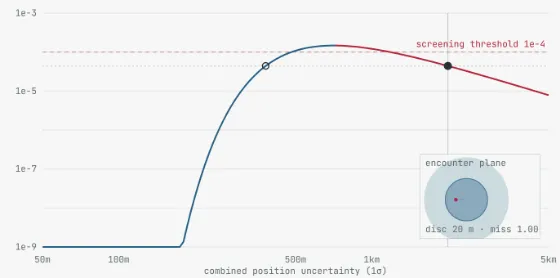
Widening the covariance on a satellite conjunction can lower its computed collision probability. Probability dilution, the non-monotonic curve behind it, and why a summary statistic can invert exactly when it matters.
-
The Kessler syndrome is misquoted
The 1978 paper describes a rate equation over decades, not a chain reaction over days. What gets lost in the retelling is the timescale, the altitude dependence, and what it implies for triage.
Engineering & games
7 posts
Concurrency, engines, platforms, and shipping games on someone else's runtime.
-
A force that does nothing
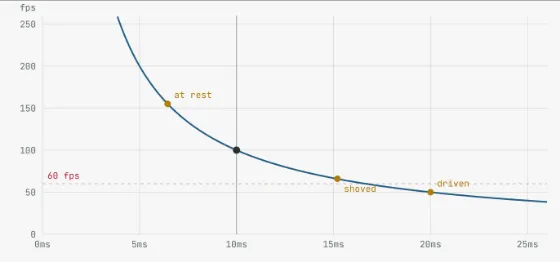
I went looking for why my game dropped from 200 fps to 40 near a boat. I found a rigid body that falls asleep with a force still on it, and stops receiving that force entirely. Two wrong theories died on the way, with interactive figures for the frame budget and the sleep timer.
-
How I made boats float
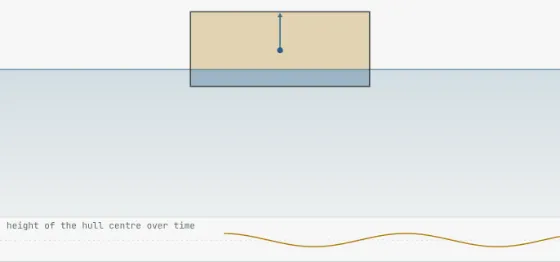
The buoyancy system behind a boat-building game I made, starting from the smallest version that floats. Then why it bounces forever, why it cannot capsize, and what sampling points actually approximates. With six interactive figures you can push, load, destabilise and capsize.
-
Instanced rendering, and the bugs it creates
Draw calls dominate cost, so engines batch. The buffer that makes batching fast is a copy of scene state, which turns correctness into an invalidation problem, and invalidation fails silently.
-
A transform bug in a scene graph
Parts inside a folder stopped following their model. The cause was an organisational node missing from the spatial hierarchy, hidden by three independently correct optimisations.
-
You cannot test a timeout by waiting for it
Structured concurrency in Luau: cooperative cancellation, cleanup scopes, and a virtual-time scheduler that turns flaky async integration tests into deterministic unit tests.
-
Determinism is not free
Send inputs instead of state and thousands of units fit down a modem. The catch is that identical code on two machines does not produce identical floating-point results unless you make it.
-
Why large worlds shake
At ten thousand kilometres from the origin, consecutive float positions are a metre apart. Sub-metre motion is not slow, it is unrepresentable, and almost every fix is a better choice of origin.
On the Arden Meridian blog
Property intelligence, solar prospecting, and how to read a research report.
-
Property intelligence should end with a decision, not another dashboard
Opinion, July 2026
-
A practical framework for ranking a solar service territory
Research, July 2026
-
How to read confidence and limitations in a property intelligence report
Research, July 2026
-
How weather exposure can change solar maintenance research priorities
Research, July 2026
-
What makes a commercial solar property worth a closer look?
Guide, July 2026
-
Five signals that can help prioritize commercial solar maintenance research
Guide, July 2026
-
What to verify before contacting a commercial property owner about solar
Guide, July 2026
-
Why system age alone is not enough to identify solar service opportunities
Industry analysis, July 2026
-
How Arden Meridian helps commercial solar teams prioritize a territory
Company, July 2026